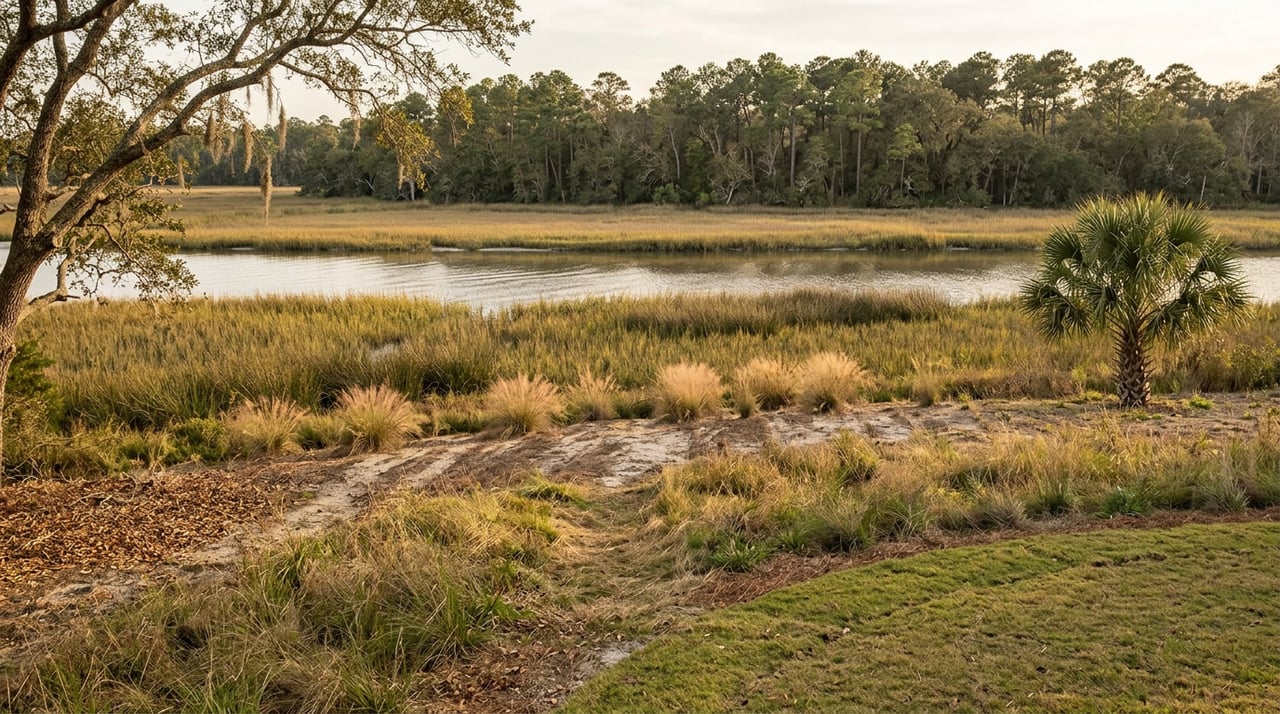
An interior homesite in Coosaw Point starts around $50,000. A riverfront parcel a few streets over, one marketed with room for a private dock, can run $200,000 to $400,000 or more. That gap isn't just about the view. Listings routinely justify it with a specific phrase: dock permitting potential. It sounds like a feature. It is actually a disclaimer, and it's worth reading closely before it becomes the reason a closing gets delayed or a buyer overpays for something that never materializes.
The Phrase Doing the Heavy Lifting
"Potential" is the operative word. No lot in Coosaw Point comes with a dock already permitted and built unless the listing says so explicitly. What buyers are paying the premium for is proximity to water plus the possibility of clearing a state permitting process that has its own rules, its own timeline, and its own preferences about how many docks a stretch of tidal creek should actually have.
That last part surprises people. It isn't that permits are simply hard to get. It's that South Carolina's coastal regulators have a stated policy preference for fewer docks per creek, not more, which changes the math on what "dock permitting potential" is actually worth.
What South Carolina Actually Reviews
Private docks in Coosaw Point fall under the jurisdiction of the South Carolina Department of Environmental Services, Bureau of Coastal Management, through its Critical Area Permitting program. A private dock is classified as a minor development activity, which puts it in a faster review lane than a marina or bridge, but faster does not mean automatic.
Two details matter most for a buyer standing in front of a waterfront lot:
First, review any approved Dock Master Plan for the section of Coosaw Point you’re considering. SCDES itself is direct about the limits of that document: a dock master plan is a guide, and having one does not guarantee that any individual dock permit will be issued. Buyers can and should ask SCDES's Beaufort office whether an approved DMP exists for the section of Coosaw Point they're considering, rather than relying on what a listing implies.
Second, the state actively encourages joint use or shared docks specifically to reduce the number of individual structures crowding a single creek. That's not a fallback position regulators reach for when a permit gets denied. It's a stated preference built into how they review applications from the start. A lot marketed as having dock permitting potential may, by design, end up sharing a structure with a neighboring parcel rather than getting an exclusive private dock. If that outcome matters to a buyer's plans, it needs to be raised and researched before the lot is under contract, not discovered afterward.
Water Access Has Its Own Fine Print
There's a second layer to this that has nothing to do with paperwork. Being on the water in Coosaw Point does not automatically mean being in deep water. The community's own boat basin, the one built from high ground and connected to the Coosaw River by a roughly 1,000-foot dredged canal, is a constructed amenity with a specific depth, not an open stretch of river. Longtime residents have pushed back publicly on the idea that Coosaw Point offers deepwater access, noting that the channel linking the community dock to the Intracoastal Waterway can run only inches deep at low tide.
That distinction matters for two different reasons depending on what a buyer is evaluating. For the community boat basin and day dock, it's a known tidal limitation that shapes what size boat can realistically use it and when. For an individual waterfront lot on the main river, the relevant depth is whatever a private survey and permit application show at that specific point on the bank, which can differ significantly from the shared community channel. Either way, the lesson is the same: verify actual water depth at the specific location, at low tide, rather than assuming "waterfront" and "deep water" mean the same thing.
What the Listing Implies vs. What to Verify
| The listing says | What it actually confirms |
|---|---|
| "Dock permitting potential" | The lot has water frontage; the permit itself has not been applied for or approved |
| "Riverfront lot" | Proximity to the Coosaw River; not a guarantee of navigable depth at that exact point |
| Price includes lot in the $200,000 to $400,000+ range | Reflects size, exposure, and the possibility of a dock, priced in before any permit exists |
Why This Matters More in Coosaw Point Specifically
Coosaw Point is a roughly 400-acre planned community on the Coosaw River, with about 400 homesites planned and more than 130 acres preserved as open space. The Forino Co. took over development in 2021, describing an investment commitment across its Beaufort and Jasper County projects that topped $300 million, and has since built out a preferred builder alliance that has included Gallant Homes, Meritus Signature Homes, Eclipse Innovation and Development, and Summerall Custom Construction. Homes built through that alliance range from the mid-$500,000s to over $1.2 million, and the community has stayed debt-free, with a property owners association fee reported at approximately $1,950 a year as of a January 2026 review.
Conditions on the water, the status of any Dock Master Plan, and SCDES's own review priorities can all shift. A dock that looked straightforward when the lot was purchased is worth re-checking before groundbreaking, not just at closing.
Before You Write the Offer
- Ask directly whether an approved Dock Master Plan covers the specific lot, and get that confirmation in writing rather than relying on marketing language.
- Contact the SCDES Bureau of Coastal Management's Beaufort office to ask about current review timelines and whether joint-use requirements are likely to apply to that stretch of the Coosaw River.
- Request or commission a current critical line survey.
- Confirm water depth at the specific point on the lot, at low tide, rather than assuming the whole community shares the same access.
- Put any agreement about who pursues or pays for the dock permit, buyer or seller, in writing in the purchase contract, the same way club initiation fees or POA transfer costs get spelled out elsewhere in Lowcountry contracts.
A Local Read, Not a Guess
None of this means dock permitting potential is a red flag. Plenty of Coosaw Point waterfront owners do end up with private docks. It means the phrase is a starting point for due diligence, not a finished feature. The difference between a lot that delivers on that potential and one that doesn't usually comes down to whether someone checked the Dock Master Plan status, the tide charts, and the survey dates before the ink dried, not after.
FAQ
Does Coosaw Point have an approved Dock Master Plan covering all its waterfront lots? That depends on the section and should be confirmed directly with SCDES's Beaufort office rather than assumed from listing language, since a DMP can exist for part of a community without covering every parcel.
If my lot doesn't qualify for its own private dock, are there other water access options? Coosaw Point maintains a community boat basin with a day dock, a boat ramp, and boat and kayak storage, which some owners use instead of pursuing an individual private dock permit.
Who typically handles dock permitting, the buyer or the builder? It varies by lot and by builder agreement, which is exactly why the responsibility and cost should be written into the purchase contract rather than assumed.
Waterfront lots in Coosaw Point can be a genuinely good long-term buy. Getting the permitting question right before you sign is what makes sure the water access you're paying for actually shows up. If you're weighing a specific lot or comparing waterfront and interior options in Coosaw Point, the Mitchell Coastal Collective Team can help you make coastal living a reality.
This article is general information, not legal, tax or financial advice. Consult a qualified professional about your situation.