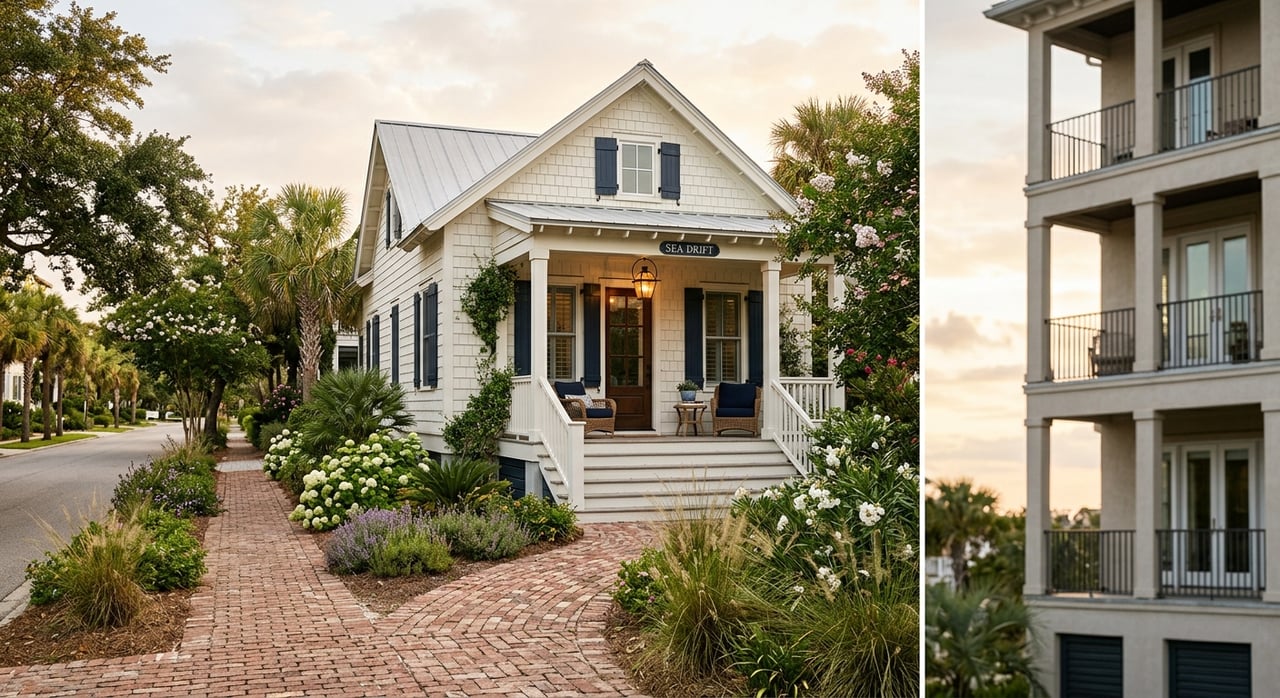
Trying to choose between a condo and a cottage in Beaufort’s Historic District? It sounds like a simple style question, but it is really an ownership question. If you are dreaming about walkable streets, porch time, and a home with real Lowcountry character, the better fit often comes down to how much maintenance, privacy, and oversight you want in daily life. Let’s break down what matters most so you can make a confident decision.
Why this choice feels different in Beaufort
Beaufort’s Historic District is not just another downtown neighborhood. The City of Beaufort describes it as the original town area, covering 304 acres, with both National Register and National Historic Landmark status.
That designation shapes how property ownership works. In this district, additions, demolitions, new construction, renovations, and site work require a Certificate of Appropriateness, and the Historic District Review Board reviews most exterior and construction-related changes.
In other words, whether you buy a condo or a cottage, you are not buying into a blank-slate property. You are buying into a preservation-minded area where exterior decisions are part of a larger historic setting.
What a condo means here
A condo in Beaufort’s Historic District usually appeals to buyers who want a simpler day-to-day setup. If you like the idea of owning a place downtown without taking on every exterior task yourself, a condo can offer that tradeoff.
Under South Carolina’s Horizontal Property Act, you own your individual unit plus an undivided interest in the common elements. That means some parts of the property are shared, and owners contribute pro rata to administration, maintenance, and repair of those common areas.
Condo maintenance is shared, not eliminated
One of the biggest reasons buyers lean toward a condo is reduced direct exterior upkeep. You may not be handling every roof issue, shared entry repair, or exterior common-area detail yourself.
But that does not mean those costs disappear. Instead, they are typically handled through association dues, reserve funding, and shared budgeting.
The law also requires condo bylaws to address care, upkeep, surveillance, and collection of common expenses. Associations must keep records of receipts and expenditures, and unpaid assessments can become a lien on the unit.
Condo rules matter as much as dues
A condo can be a good fit if you are comfortable with a more communal form of ownership. Because common elements are shared and managed through the association, your experience depends partly on board governance, budgets, and house rules.
That structure can feel convenient for a buyer who wants a lock-and-leave property. It can feel limiting for someone who wants broad control over shared spaces or decision-making.
The association also must insure the property against risks. If repair or replacement costs exceed available insurance proceeds and reserves, the excess is treated as a common expense, which helps explain why special assessments are an important question to ask before you buy.
Historic rules still apply to condos
Some buyers assume a condo avoids most historic district restrictions. In Beaufort, that is not really the case for exterior work or site changes.
If proposed work affects the exterior or the site, the city’s historic review process still applies. So while condo ownership may reduce your personal maintenance load, it does not remove the district’s preservation framework.
What a cottage means here
If a condo is about shared systems, a cottage is about direct stewardship. In Beaufort’s Historic District, cottages are closely tied to the area’s long-standing residential character.
The city’s planning documents note that smaller one- to one-and-a-half-story cottages were the primary modest residential form in several neighborhoods, often with front porches facing the street. That helps explain why cottages often feel so naturally at home in this part of Beaufort.
Cottage ownership offers more control
For many buyers, the biggest draw of a cottage is the feeling of having a stand-alone home. You are generally working with your own structure, your own outdoor areas, and a more private setup.
That can be especially appealing if you want porch living, a house-like feel, and more say over how the property is used and maintained. In a historic district known for preserved architecture and walkable blocks, that ownership style can feel deeply personal.
Cottage ownership brings more upkeep
That added control usually comes with more direct responsibility. Beaufort’s preservation guidance puts strong emphasis on porches, exterior materials, and architectural details.
The city’s Preservation Manual describes the porch as the principal element in residential sections of the district and even notes that it acts like an outdoor living room. It also points out that porches require constant maintenance and that traditional structural details help preserve the building.
For you as an owner, that often means being more hands-on with painting, drainage, porch repair, roofing, landscaping, and exterior maintenance. A cottage may give you more autonomy, but it also makes you the point person for more visible property issues.
Cottage changes face closer review
If you hope to alter a cottage over time, it is important to understand the review process early. Exterior changes, additions, renovations, and site work require a Certificate of Appropriateness in the historic district.
The Preservation Manual also says additions and alterations should not destroy historic materials and should remain compatible in massing, size, scale, and architectural features. So if your vision includes major exterior changes, the district’s design standards should be part of your buying decision from the start.
Comparing the lifestyle fit
For most buyers, this decision is less about square footage and more about how you want to live. Both property types can work well in Beaufort’s Historic District, but they support different ownership styles.
Here is a simple side-by-side view:
| Feature | Condo | Cottage |
|---|---|---|
| Day-to-day upkeep | Less direct exterior maintenance | More direct exterior maintenance |
| Ownership structure | Shared common elements | Stand-alone home model |
| Privacy | More communal | More private |
| Rules | Association rules and dues | City preservation rules, no condo association structure by default |
| Exterior control | More limited in shared settings | More direct control, but still subject to historic review |
| Best fit for | Lock-and-leave buyers | Buyers who want hands-on ownership |
Costs to weigh before you choose
Budget is not just about purchase price in Beaufort’s Historic District. Your long-term costs can look very different depending on taxes, flood exposure, dues, and maintenance needs.
Property taxes depend on how you use the home
In Beaufort County, a primary residence is assessed at 4% of appraised value, while secondary residences and other residential property are assessed at 6%. The county explains that this assessment ratio is used to determine assessed value before the millage rate is applied.
That means your intended use matters. Whether you buy a condo or a cottage, the tax picture may shift significantly if the home is your legal residence versus a second home.
Flood costs can affect either option
Flood risk is a real budgeting factor in Beaufort. The city notes that flooding can occur anywhere in town because of flat topography, marshes, tidal rivers, storm surge, and heavy rain.
The city also states that standard homeowner’s insurance does not cover flood damage. Flood insurance is available to both homeowners and condo owners, and it is mandatory in Special Flood Hazard Areas shown on FEMA flood maps.
For many buyers, the monthly cost of flood insurance can matter just as much as the difference between condo dues and cottage upkeep. That is why flood zone review should be part of your comparison process.
Historic incentives may help with rehabilitation
If you are considering an older historic property, preservation incentives may be worth exploring. The City of Beaufort says historic properties may qualify for federal, state, and local incentives, and it identifies the local Bailey Bill as a 10-year tax abatement tool.
According to the city’s Bailey Bill FAQ, an owner must invest at least 75% of the building’s fair market value back into the building. If approved, the assessed value can be frozen at the pre-rehabilitation value for 10 years.
These incentives may be especially relevant for older cottages, though any qualifying historic property should be evaluated individually.
Which buyer usually prefers a condo
A condo often makes sense if you want Beaufort charm with fewer direct exterior responsibilities. It can be especially appealing if you plan to use the property as a second home and value a more lock-and-leave setup.
You may prefer a condo if you want:
- Less hands-on exterior maintenance
- A simpler day-to-day footprint
- Shared management of common areas
- A more structured ownership model
- Comfort with dues, association rules, and possible special assessments
Which buyer usually prefers a cottage
A cottage often makes sense if the home itself is part of the dream. If porch life, stand-alone ownership, and a stronger sense of architectural stewardship matter to you, a cottage may feel more rewarding.
You may prefer a cottage if you want:
- More privacy
- A house-like feel
- Direct control over your property
- Historic porch character
- Comfort with ongoing maintenance and approval requirements for exterior changes
The smartest way to decide
In Beaufort’s Historic District, the better question is not which option is better overall. The better question is which responsibilities you want to manage yourself.
A condo usually shifts more of the exterior burden into a shared system with dues and rules. A cottage usually gives you more independence, but asks more of you in upkeep, planning, and architectural care.
If you are buying from out of town, this difference matters even more. The right fit often depends on how often you will be here, how hands-on you want to be, and whether you want your ownership experience to feel more managed or more personal.
If you are weighing a condo against a cottage in Beaufort’s Historic District, the best next step is to compare specific properties through the lens of maintenance, flood exposure, tax status, and historic review. The Mitchell Coastal Collective Team offers hands-on local guidance to help you sort through the details and choose the Lowcountry property that fits the way you want to live.
FAQs
What is the main difference between a condo and a cottage in Beaufort’s Historic District?
- A condo usually offers less direct exterior maintenance and more shared ownership responsibilities, while a cottage usually offers more privacy and control but more hands-on upkeep.
Do Beaufort Historic District rules apply to both condos and cottages?
- Yes. In Beaufort’s Historic District, exterior changes, additions, renovations, new construction, demolitions, and site work require city review through the Certificate of Appropriateness process.
Are condo owners in Beaufort responsible for common-area costs?
- Yes. Under South Carolina law, condo owners share responsibility for common expenses, maintenance, and repair through the ownership structure and association assessments.
Are cottages in Beaufort’s Historic District harder to maintain?
- They can be more maintenance-intensive because owners are usually directly responsible for exterior elements like porches, roofing, painting, drainage, and landscaping.
How do Beaufort County property taxes affect condo and cottage buyers?
- Property taxes depend heavily on whether the home is your primary residence or a secondary residence, with primary residences assessed at 4% of appraised value and secondary residences assessed at 6%.
Do condo and cottage owners in Beaufort both need to think about flood insurance?
- Yes. The City of Beaufort says flooding can occur anywhere in town, standard homeowner’s insurance does not cover flood damage, and flood insurance may be mandatory in Special Flood Hazard Areas.
Can a historic Beaufort property qualify for tax incentives?
- Some historic properties may qualify for preservation incentives, including local tools like the Bailey Bill, depending on the property and the scope of rehabilitation.